Why content structure matters more than content volume.
Publishing more content does not guarantee better visibility. In many cases, it creates confusion.
Search engines and AI systems need to understand how your pages connect, what each page is about, and why the information is useful. More content can help, but only when it is organised, consistent, and purposeful.
Content Reality Check
A bigger website is not automatically a better website. Without structure, content can overlap, compete, confuse users, and weaken AI understanding.
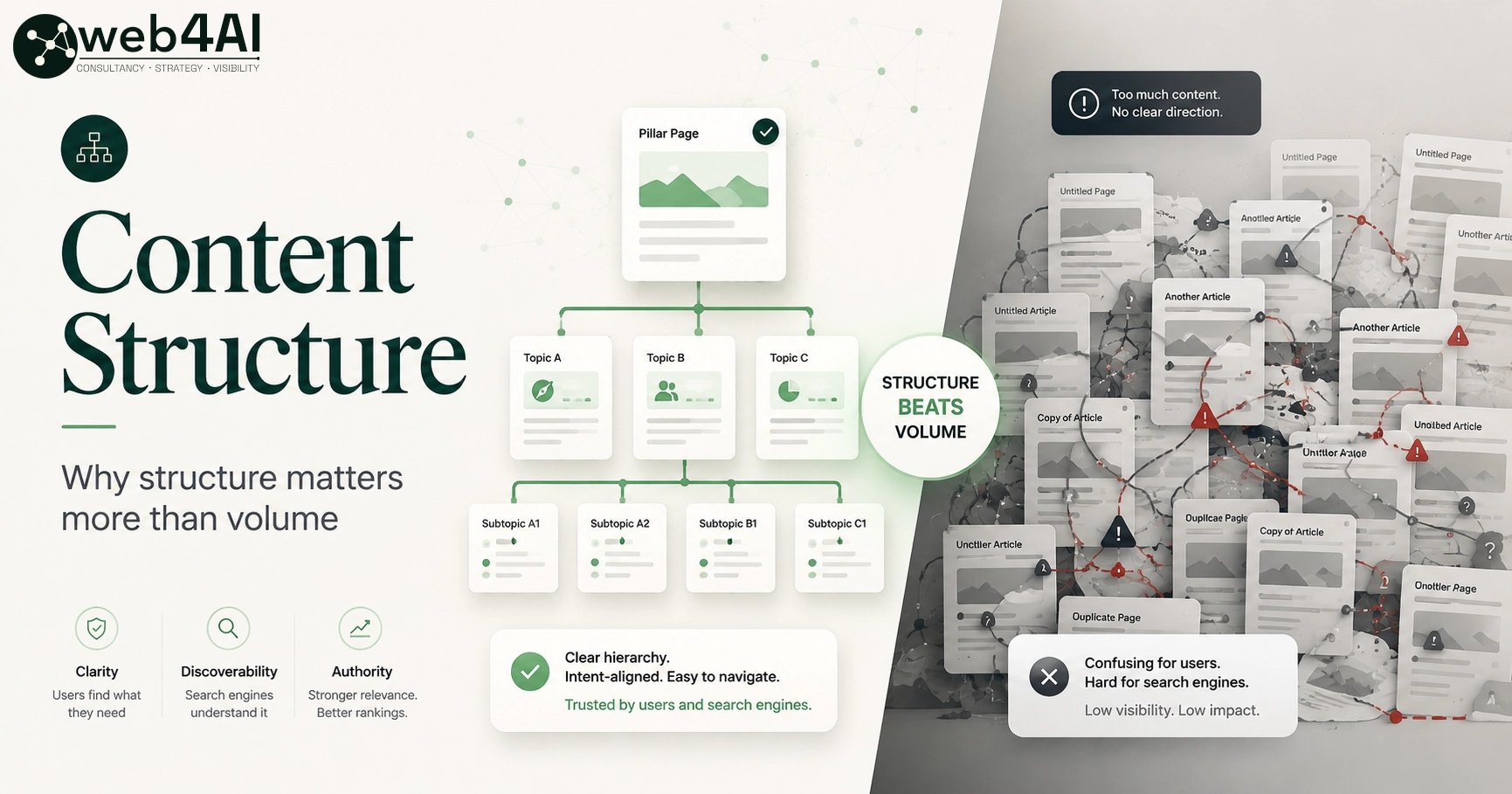
Clear content structure helps users, search engines and AI systems understand which pages matter, how topics connect and why the information can be trusted.
More content can create more confusion.
A lot of businesses assume that the answer to poor visibility is to publish more content. More blogs. More service pages. More location pages. More FAQs. More words.
Sometimes that helps. But only when the content has a clear purpose and fits into a wider structure. Without that structure, extra content can make the website harder to understand.
Pages start to overlap. Similar topics compete with each other. Service descriptions become inconsistent. Internal links are added randomly. Visitors are left unsure which page matters most.
Why structure is a stronger visibility signal than volume.
Content volume can support visibility, but it does not create clarity on its own. Search engines and AI systems need to understand what each page is for, how pages relate to each other, and which information should be trusted.
Structure gives each page a clear job
Every important page should have a defined purpose. A service page, location page, blog post, and FAQ should not all try to do the same thing.
Clear hierarchy shows what matters most
A strong website makes it obvious which pages are central, which pages support them, and how the wider topic is organised.
Consistency reduces ambiguity
If different pages describe the same service in different ways, the website becomes harder to interpret. Consistent language strengthens meaning.
Internal links explain relationships
Internal links are not just for navigation. They help show how services, locations, topics, articles, and proof points connect.
Thin pages dilute trust
Adding lots of small, weak pages can make a site feel busy without making it more useful. Stronger pages usually explain more with better intent.
Structured content is easier to summarise
AI systems rely on clear, well organised information. If your content is messy, vague, or repetitive, it becomes harder to use confidently.
More content is only useful when it makes the website clearer. If it creates overlap, contradiction, or confusion, it can weaken visibility rather than improve it.
Check Your WebsiteA messy website makes AI interpretation harder.
AI systems work best when information is clear, consistent, and well connected. They need to understand what your business does, what each page means, and how the content fits together.
If your site has multiple pages saying similar things in slightly different ways, it can become unclear which page is the most useful source. That can weaken confidence.
The same problem affects users. If someone lands on your website and cannot quickly understand where to go next, what service applies to them, or why they should trust you, more content has not helped. It has added friction.
Structure matters because it turns a collection of pages into a coherent source of information.
Content Volume
More pages, more words, more topics, more opportunities to appear.
Content Structure
Clear page purpose, logical hierarchy, consistent messaging, and meaningful internal links.
Weak Approach
Publishing content because there is a keyword opportunity, without checking how it fits into the wider site.
Stronger Approach
Building a content system where each page has a job, supports the right topic, and makes the business easier to understand.
How to build content that supports understanding.
The answer is not to stop publishing content. The answer is to publish with structure. Every new page should have a purpose, a place, and a clear relationship to the rest of the website.
Map the main service pages
Start with the core services that matter commercially. These should be the clearest, strongest, and most complete pages on the site.
Use supporting content properly
Blog posts and FAQs should support main pages, not compete with them or repeat them in weaker form.
Create meaningful internal links
Link related pages in a way that explains context, not just for the sake of adding links.
Keep language consistent
Describe services, locations, audiences, and outcomes consistently so humans and AI systems get the same message.
Better structure often beats more content.
Before publishing another page, check whether your existing content is clear, connected, and doing the job it was meant to do.
Content only helps when it makes your website easier to understand.
Publishing more content can be useful, but only when it adds clarity. If it creates overlap, duplication, inconsistency, or weak supporting pages, it can make your website harder to interpret.
For AI visibility, the structure behind the content matters. Search engines and AI systems need to understand which pages are important, how topics connect, and why your business should be trusted.
The strongest websites are not always the biggest. They are the clearest, most consistent, and easiest to use as a reliable source.
Structure gives meaning
Clear hierarchy helps users, search engines, and AI systems understand what each page is for.
Links create relationships
Internal links show how services, articles, locations, evidence, and next steps connect.
Consistency builds confidence
Repeated, clear, accurate messaging makes your business easier to interpret and trust.
If your website is not performing as expected, there is usually a reason.
These insights give you a starting point. The audit shows how the same ideas apply to your site.
Specific to your business. No obligation.
Prefer to keep reading first? Browse more insights as the library grows.